
Tokenized Luxury Real Estate Breaks New Ground:
Inside the Trump–Dar Global Maldives Development
The World’s First Development-Phase Tokenized Luxury Hotel
On November 18, 2025, Ecoinimist broke a story that immediately reverberated through both the luxury real estate and blockchain communities:
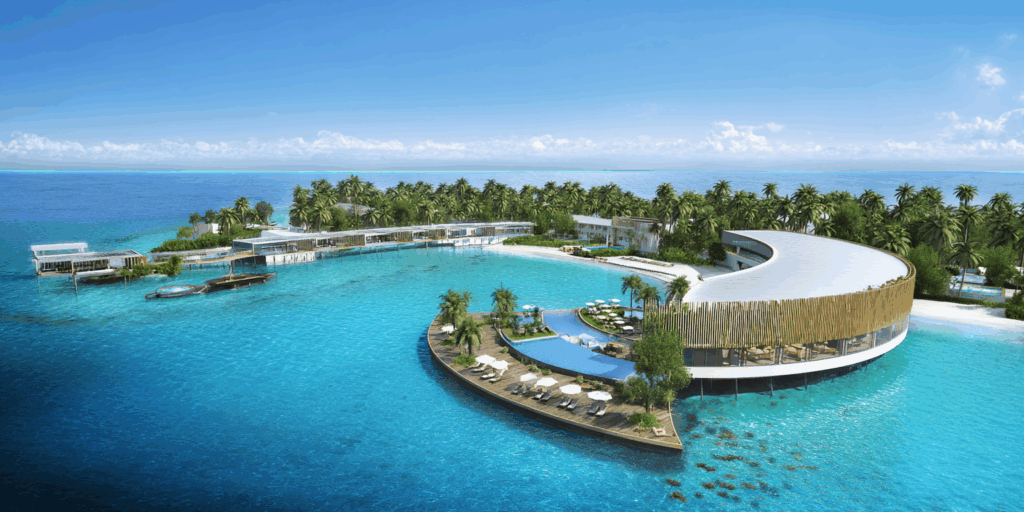
The Trump Organization is partnering with London-listed luxury developer Dar Global to launch Trump International Hotel Maldives, a high-end resort billed as the world’s first tokenized hotel development.
What makes this deal especially significant is not just the scale or the branding — it’s the structure.
This project isn’t tokenizing a finished property — it’s tokenizing the development phase itself.
This represents a major evolution from earlier real estate tokenization experiments, most of which focused on already-built or revenue-generating assets. Instead, the Trump–Dar Global project pushes tokenization upstream, enabling investor visibility — and potential participation — before construction is complete.
Real-world asset (RWA) tokenization has been gaining momentum for years, but this model signals a deeper shift:
early-phase luxury development is moving on-chain.
Why This Deal Matters
1. A New Funding Blueprint for Luxury Development
Tokenizing a pre-construction project introduces a new financing model for high-end real estate. According to Ecoinimist, the approach enables:
- earlier investor access
- expanded global participation
- fractional exposure to luxury assets
- increased transparency in development financing
For developers, tokenization can open additional capital pathways during critical early stages — traditionally the hardest to fund.
2. Real-World Assets (RWA) Are Entering a High-Growth Cycle
Timing matters.
Tokenized real-world assets are accelerating quickly, driven by:
- rising institutional involvement
- maturing blockchain infrastructure
- better regulatory clarity
- expanding demand for asset-backed tokens
The Maldives project is one of the first high-profile examples of tokenization at a global brand scale.
3. Luxury + Blockchain Is Becoming a Strategic Pairing
The Trump International Hotel Maldives will feature ~80 overwater and beachfront villas, designed for high-net-worth clientele. Tokenizing a luxury development accomplishes two strategic goals:
Visibility
Luxury brands generate attention, accelerating mainstream awareness of tokenization.
Innovation
Developers can experiment with new hybrid financing models without disrupting mid-market operations.
The intersection of luxury hospitality and blockchain is becoming a proving ground for capital innovation.
4. A Strategic Web3 Expansion for the Trump Organization
This isn’t Trump’s first move into blockchain-integrated real estate.
Past explorations include:
- crypto payment options for Trump Tower Dubai
- Web3-aligned financing models
- partnerships showcasing digital asset integration
The Maldives announcement appears to be part of a long-term strategy rather than a one-off experiment.
Challenges & Risks to Watch
As with any emerging financing model, challenges remain:Regulatory Uncertainty
Cross-border luxury hospitality tokenization spans multiple legal jurisdictions.Liquidity Expectations
RWA tokens often behave differently than purely financial tokens; liquidity is rarely instant.Execution Complexity
Tokenizing an 80-villa luxury development requires seamless coordination between:- construction
- legal
- compliance
- blockchain partners
- investor relations
What This Means for the Tokenization Landscape
Beyond the specifics of Trump and Dar Global, this project validates several broader market transitions:
1. Development-Phase Tokenization Is Emerging as the Next Frontier
Early-stage tokenization could fundamentally reshape how large projects raise capital.
2. Major Brands Are Entering the Tokenization Market
This accelerates credibility and institutional comfort.
3. Token Rails and RWA Infrastructure Are Maturing Rapidly
The tech stack required for institutional-grade tokenization is finally strong enough.
4. Luxury Real Estate May Become a Flagship Use Case
If successful, expect tokenization to expand into:
- branded residences
- marinas
- yachts
- trophy assets
- architectural landmarks
Luxury is often the first adopter of new capital models.
What This Means for MSCG and XYLE (Compliant Version)
Implications for MSCG
While MSCG is not affiliated with the Maldives project, the development reinforces why structured documentation, transparent project readiness, and responsible capital models are essential in today’s evolving funding landscape.
The direction global token markets are moving — toward clarity, integrity, and scalable structures — aligns strongly with MSCG’s external messaging and mission.
Implications for XYLE
For XYLE, which focuses on developing secure, compliant RWA token rails, the Maldives announcement is a significant market signal.
It validates trends XYLE already aligns with:
- development-phase tokenization
- compliant token issuance
- institutional-grade asset rails
- integration of blockchain liquidity with real assets
- demand for fractionalized ownership frameworks
XYLE is not involved in the Maldives development — but this kind of high-profile tokenization model strengthens the broader RWA category that XYLE operates within.
This strengthens the overall case for compliant tokenized infrastructure.
Final Thought: A New Era of Tokenized Luxury Development
The Trump International Hotel Maldives is more than a luxury resort — it’s a signal of where global real estate financing is heading.
This model — if successful — could spark a wave of tokenized luxury developments around the world.
Compliance Note
MSCG and XYLE have no affiliation with the referenced development.
This article is commentary based solely on publicly available information and does not constitute investment advice.
Partner Organizations
Michigan Secure Capital Group is proud to partner with these firms.